Rising pressure to reduce emissions
Mike Wells, Vice President of Product Management and Innovation at Nikkiso CE&IG, considers the opportunity to reduce emissions from vessels by increasing the pressure of fuel gas supply systems.
14 April 2026
The marine sector has been committed to reducing its carbon emissions and playing its part in the journey to net zero for many years. Today, that long-standing commitment is gathering real momentum, as regulatory pressure and technological maturity turn ambition into action across the global fleet.
Much of this shift can be traced back to the International Maritime Organization’s (IMO) decarbonization commitments outlined in 2023. These measures underpin the IMO’s response to UN Sustainable Development Goal 13 – urgent action to combat climate change – and have become a key catalyst for the changes now reshaping marine propulsion and fueling strategies.
Against this backdrop, the limitations of traditional propulsion systems are becoming increasingly apparent. For decades, most commercial marine vessels have relied on petroleum-based fuels such as heavy fuel oil (HFO). However, as the global shipping industry accelerates toward decarbonization and tighter emissions standards, the demand for alternative fuel sources capable of delivering meaningful carbon reductions is rising.
Among those alternatives, LNG has been used as an alternative fuel to HFO and marine diesel oil on board ships for decades. Since the early 1960s, LNG has been used extensively aboard LNG carriers, where natural boil-off from atmospheric cargo tanks is utilized to meet propulsion and electrical powering demands. This approach not only improves operational efficiency, but also significantly reduces emissions compared with conventional heavy fuel oil and diesel.
What was once a niche solution has now become a mainstream option. Since 2008, global shipping emissions regulations have become progressively tighter with reduction targets introduced for sulfur oxide and nitrogen oxide and, more recently, carbon dioxide. These targets set by the EU Emissions Trading System and FuelEU Maritime, alongside IMO, are designed to achieve net-zero greenhouse gas emissions by 2050. As a result, LNG has emerged as the most attractive fuel option for a wide range of vessel types and sizes, accelerating demand for efficient and robust fuel gas supply systems (FGSS).
A typical FGSS is designed to transfer the LNG stored in a cryogenic containment tank (whether pressurized or atmospheric) at the required temperature and pressure conditions to the ship’s main consumers, such as the main propulsion engine and the generating sets which can be either two-stroke low-pressure, two-stroke high-pressure, and/or four-stroke low-pressure systems, and the boilers.
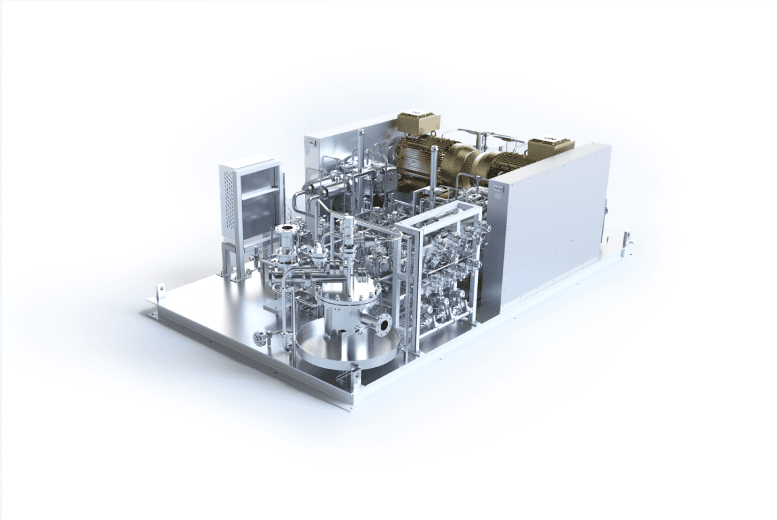
Figure 1 depicts a fuel gas supply system (FGSS)
Within these systems, the most critical and technically demanding component is the pumping unit. In high-pressure FGSS configurations, the pumping unit provides the main propulsion power of the ship at delivery pressure of up to 385 bar. Cryogenic reciprocating piston pumps have proven to be the most efficient method and reliable solution for meeting these demanding operating conditions.
Each FGSS consists of a set of redundant reciprocating piston pumps that are directly driven by electric motors through a gearbox or a belt drive, and supported by a dedicated lubrication system supplying oil to the warm ends (Crankcases) of the pumps. All the necessary controls, piping, valves, safety devices, and instrumentation are mounted on a common structural steel base or skid, providing a modular turn-key solution for integration aboard vessels.
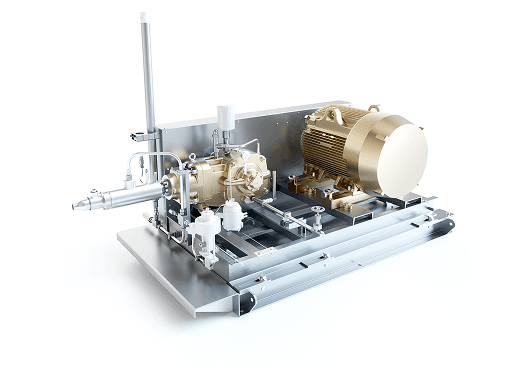
At the heart of the FGSS are the cryogenic reciprocating pumps. The cryogenic reciprocating pump consists of a ‘warm end’ or drive assembly that converts rotary motion from the electric motors into reciprocating motion, and a ‘cold end’ where the cryogenic liquid is pressurized from low pressure to high pressure. The warm end is of a modular design that lets the pump be configured with the optimum number of cold ends for a given application.
Figure 2 the cryogenic reciprocating pump consists of a ‘warm end’ or drive assembly that converts rotary motion from the electric motors into reciprocating motion, and a ‘cold end’ where the cryogenic liquid is pressurized from low pressure to high pressure.
An intermediate housing connects and thermally isolates the warm end housing from each cold end cylinder housing, protecting mechanical components in the warm end from extreme cold temperatures. The warm end components (bearings, crosshead, and wrist pin) are pressure lubricated by an external oil lubrication system to ensure reliability during continuous operation. The cold ends use specialized cryogenic piston seals to pressurize the fluid and minimize boil-off gas generation.
As propulsion technologies continue to develop in response to tightening emissions regulations, the utilization of higher LNG and ethane fuel pressures have been found to enable more efficient engines, directly translating into reduction in carbon emissions. As a result, recent research and innovation have focused on developing engines and fuel systems capable of operating at 380 bar, 420 bar, and beyond.
As marine engine injection pressures increase, the design and manufacture of high-pressure FGSS introduce a series of complex technical challenges. Operating at pressures of 380 bar and above increases mechanical loads on pumping components, intensifies sealing and efficiency requirements, and places greater emphasis on material selection, particularly for wearing components such as bearings, piston seals, and packing seals, as well as system components such as valves, flanges, and instrumentation.
Sustained high-pressure operation requires careful optimization of pump hydraulics, tight manufacturing tolerances, and effective thermal separation between warm-end drive assemblies and cryogenic cold-end components. At elevated pressures, minor deviations in alignment can have a disproportionate impact on reliability and service life.
Operational experience from high-pressure FGSS systems deployed in LNG vessels has highlighted the importance of long-duration service data in validating design assumptions. Extended operating experience at pressures exceeding 380 bar, and in some applications approaching 500 bar, has provided valuable insight into wear behavior, sealing performance, lubrication regimes, and maintenance requirements. These findings continue to inform the evolution of FGSS designs as the marine sector moves toward higher-efficiency engines and a broader mix of low-carbon and alternative fuels.
Supporting shipyards through the standardization of FGSS systems is critical as emissions requirements become more stringent year over year, allowing a single design rated for up to 500 bar to be utilized repeatedly well through the next 10 years of shipbuilding. This reduces the risk of needing to redesign fuel preparation spaces on vessels as fuel pressure requirements potentially continue to rise.
As emissions regulations increasingly require operators to meet average performance targets across their fleets, older vessels will continue to be phased out and replaced by ships fueled by alternative fuels or higher-pressure engines. In this evolving regulatory and technological landscape, flexibility is critical.